In my many years of working with intranets, I have always said that content is king. When your content is written and structured well, systems that use the content work better. This was always true for the intranet search engine. Now this includes AI.
Last year, I worked on a proof of concept to see if I could create a RAG (Retrieval-augmented generation) interface to work with content on a test intranet. My previous blog post explains how I used Pinecone for a vector database and OpenAI for the LLM.
The results were amazing. But storing client data on external sites is not an option for my client intranets. So, I started a project to build a self-contained AI, integrated with Govintra.
I partnered with a small agency, with as much experience in AI as I have in intranets. The first hurdle was the assumption that this new AI server would crawl my client intranets from outside. Not possible when all intranets are protected with SSO login. I wanted instant indexing, similar to how Relevanssi, our current search solution, works on intranets. There’s a full index option. Then content is indexed on the fly as new posts are created and existing content is updated or deleted. I can’t think of anything worse than an overnight crawl; search results are always out of date. I didn’t want this for the RAG interface.
“Agento Intelligence” is the name of the new service, and also the name of the plugin that I created to integrate Govintra with the AI server. The service is hosted in the UK, ring-fenced with my client intranet landscape. It uses open source models, so no content is transferred to other platforms such as Gemini, Co-pilot, Chat-GPT or Claude. There is no training on client data.
The AI service uses a vector database for each client, to embed chunks from intranet content, and a LLM (Large Language Model) to serve answers to questions, and rewrite content. We are also experimenting with a vision model for OCR tools.
The Agento Intelligence plugin sits within the Govintra CMS, indexing content in real-time. It gives us a new ‘search box’ to use, allowing staff to ask natural language questions. Questions are sent to the AI server with an API key, matched to content in the client vector database, and the LLM returns an answer. Staff get realtime answers based on current intranet content.
Several layers of security are built in. The AI can only be accessed from client intranets and requires an API key. Staff questions are passed through a sanitisation checker and all inappropriate content is returned immediately with an “I can’t answer that” response. We don’t want staff getting saucy with the AI, asking how to make bombs or plotting to assassinate the King.
Prompts are in place instructing the LLM only to return answers from the source intranet context, and to respond “I don’t know” instead of hallucinating answers when an answer doesn’t exist. We guard against prompt injection, and always cite source intranet pages to show where answers came from.
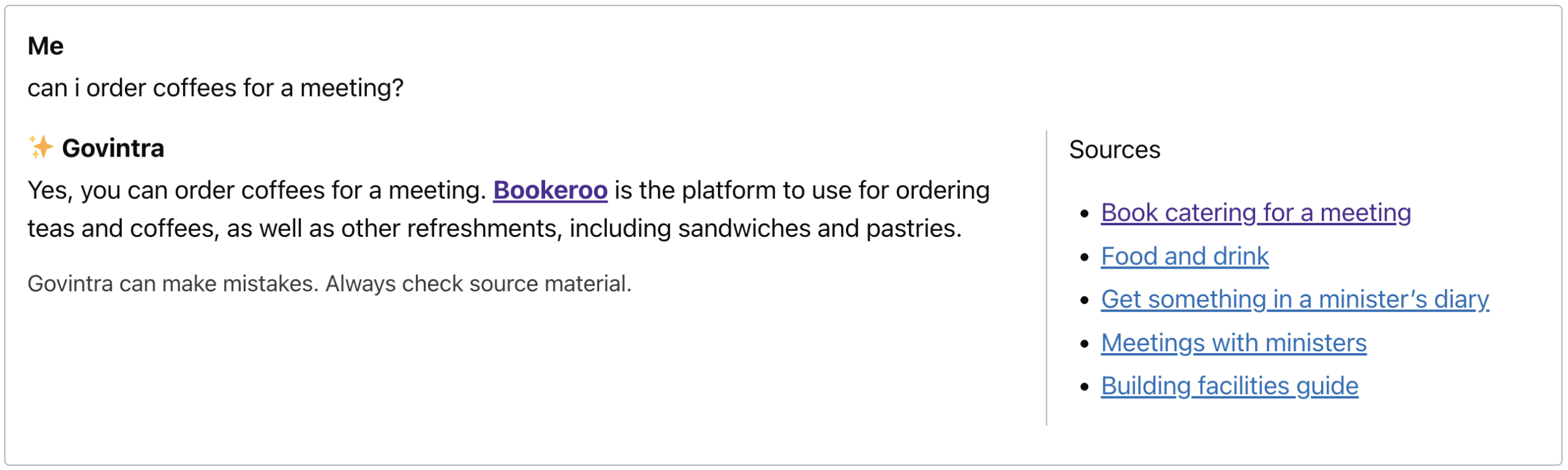
You can try out the RAG interface from the demonstration intranet site.
I also built a content rewriter tool, designed to allow editors to alter content using AI prompts. Examples are to rewrite content using your house style, giving consistent formatting to dates, numbers, product names etc. In this video, I demonstrate how I used it to clean HTML:
As I prepare to launch the new Agento Intelligence system with an existing client, I have great optimism that it will work well, because the content is written well. They have followed the ‘tasks and guides’ method of splitting up guidance content into manageable parts. The majority of guidance is stored as HTML content, not buried in PDF documents.
But for other intranet clients, their guidance sections act as signposts handing off to external Sharepoint and Google documents. They do a good job acting as signposts, bringing staff to the intranet, and highlighting documents that are otherwise hard to find by searching Sharepoint. But the content lives outside of the intranet, buried in Microsoft Word and PDF documents. The AI plugin won’t read documents in external platforms.
Although it has been an exciting process to develop the new AI system, I have not tested it on a live intranet yet. I’ve been working with demo data, testing with questions that I have thought of. The real test will be using real intranet content with questions from live users. I look forward to starting to work with the client to get feedback and make further iterations as we explore this technology.
In the same way that I have followed client feedback to guide the direction of Govintra development, I’ll use the same iterative development to improve Agento Intelligence. And as with SEO, I’m sure that we’ll also need to tweak some content to make it work better with the AI.
The proof is in the pudding. Watch out for updates as we roll out and receive feedback.
Still using keyword search? Let’s talk.